

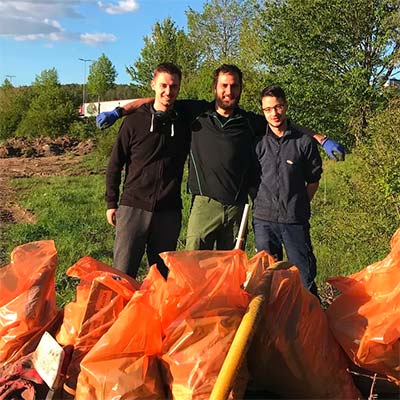

An engineer at Airbus. A secure salary. A good career. A job many envy you for. And then you quit. In the middle of Corona. To fish plastic out of the ocean. Sounds crazy? Welcome to my life 🌊
My name is Dominik Karl, I am the founder of Oceanmata. And this is the story of how a kitesurfer from Southern Germany, via Airbus, Sri Lanka, and Bali, came to found a company that makes the ocean a little cleaner.
https://shopify-staged-uploads.storage.googleapis.com/tmp/245956671/files/d714daae-9bac-4add-a14c-3d419a364f92/art3_img0.jpgImage credit: @petepontone
Chapter 1: A boy, a kite, and a winch 🪁
It all starts at the quarry lake. I'm 12, secretly ordered a kite on eBay, and teach myself kitesurfing. The result: a broken arm. And a lifelong passion.
"I started kitesurfing at 12. It showed me this connection to the ocean."
From then on, I was obsessed. Every weekend to the North Sea, every holiday on the water. I got really good – so good that I got my first sponsors and seriously thought about becoming a professional.
"I was at a point where I could have made kitesurfing a profession. I got my first sponsors."
But Southern Germany and professional water sports – that doesn't fit together. "The extreme distance to the sea – it's good if you live by the sea to really train kitesurfing well." So I did what I did best: find a solution.
"Back then, I built myself a small wakeboard system, a winch, so I could practice when there was no wind."
A teenager who builds his own winch to train despite lack of wind. In retrospect, that was already the engineer in me – and the entrepreneur. If you want to read the detailed kitesurfing story, check out Kitesurfing on the North Sea.
Chapter 2: Airbus – Dual study and secure career ✈️
The dream of professional sports was over, but I needed a new one. I chose mechanical engineering – a dual study program at DHBW Heidenheim in combination with practical phases at Airbus.
It was an intense time. Theory at the university, practice at one of the largest aerospace companies in the world. I learned how to systematically solve complex problems, how to work in large teams, how to bring projects from idea to implementation.
As the DHBW later described it: "The experience at Airbus was perfectly linked to theoretical knowledge." And that's true. Everything I learned there, I use today at Oceanmata – only now I don't build airplanes, but a system that frees the ocean from plastic.
Airbus was a great employer. Secure salary, exciting projects, good colleagues. But deep down I knew: This is not my endpoint. Something was missing.
Chapter 3: The Turning Point – Sri Lanka and the Crushing Truth 🇱🇰
Then came Sri Lanka. Matara, a small village on the south coast. I was there for surfing – and was confronted with a reality I hadn't expected.
"It started in Matara, a small village in Sri Lanka. I was there for surfing and the amount of trash was crushing."
Plastic. Everywhere. On the beach, in the streets, in the rivers. And in the evenings, on the way home from the surf session, I saw it again and again:
"In the evenings on the way home, I often saw the wind blowing all the trash into the sea."
This was no longer an abstract environmental problem you see in a documentary. This was real. Right before my eyes. The ocean I loved so much was becoming a dump. And no one was doing anything about it.
Chapter 4: Bali – The Local in Medewi
In Bali, the picture became even clearer. In Medewi, a small surfing village on the west coast, I met a local who collected plastic alone on the beach every day. Without pay. Without an organization. Simply because he thought it was right.
This man taught me more than any seminar on sustainability. If a person who barely has enough himself stands up for the ocean every day – what's my excuse?
The answer: There isn't one. You can find more about Medewi in our article Medewi, Bali – Plastic Hotspot and Oceanmata's Home.
https://shopify-staged-uploads.storage.googleapis.com/tmp/245956671/files/22828576-410b-412e-bea4-139d6acda095/art3_img1.jpgImage credit: @afuafex
Chapter 5: The Resignation – 2020, in the midst of Corona 🦠
2020. The world stands still. Lockdown. Uncertainty everywhere. And what do I do? I quit my secure job at Airbus.
My family thought I was crazy. My friends were skeptical. And honestly, I was scared myself. But I knew: If I don't do it now, I'll never do it.
The idea was clear: Don't see plastic as trash, but as a valuable raw material. Develop products that people love – and with every product sold, remove 1 kg of plastic from the ocean. That's how Oceanmata was born.
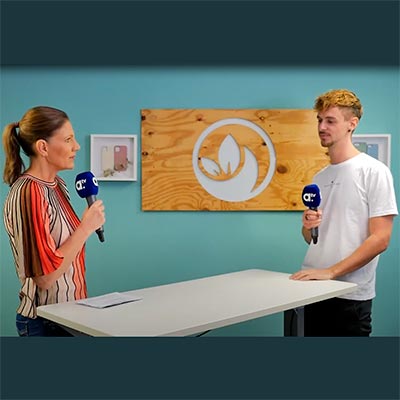
As the Augsburger Allgemeine later summarized it: "Buy a sustainable phone case and remove one kilogram of plastic from the sea." Ocean protection can be that simple.
Chapter 6: The Crisis – 2021, when growth becomes a problem 📉
What many don't see: The path was anything but straightforward. In 2021 came the first major crisis.
We had grown too fast. Too much ordered, the warehouse full, Christmas business didn't go as planned. I sat there looking at a sinking bank account – and wondered if it was all a huge mistake.
They were tough months. Sleepless nights. Moments when I wanted to go back to Airbus. But then I thought of the man in Medewi. Of the mountains of plastic in Sri Lanka. Of all the people who had written to us that Oceanmata gave them hope.
So I sat down and rebuilt everything. No longer just growth at any cost. But: achieve great things with small things. Fewer products, but better ones. Less speed, but more substance. And above all: never lose sight of the mission.
Chapter 7: Back to the Mission – The True Compass 🧭
The crisis was the best teacher. It showed me that Oceanmata has to be more than a shop. It has to be a movement. A community of people who understand: Every small decision counts.
We focused everything on the core mission:
- 1 product = 1 kg plastic from the ocean – measurable, transparent, real
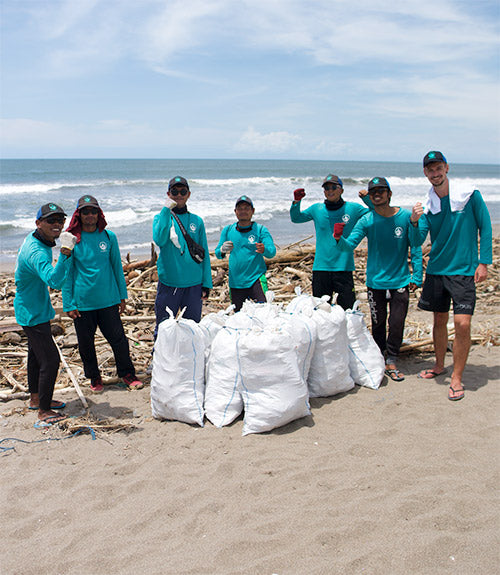
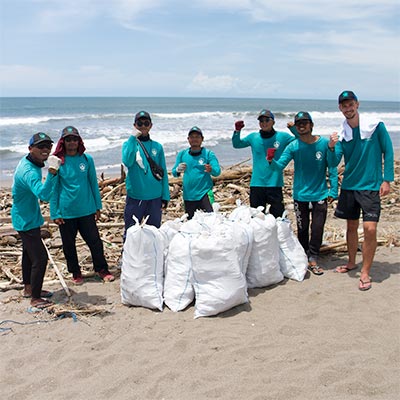
- Team Medewi: 11 employees in Bali who collect ocean plastic daily
- Community: Over 165,000 ocean heroes
- Production: Made in Augsburg – short distances, high quality
In 2025, we received the "Made in Augsburg" award from the DAZ – a recognition that shows that sustainability and local value creation belong together.
Chapter 8: Today – 300,000 kg and a vision 🌍
As of today, we have removed over 300,000 kg of ocean plastic from the sea. That's 300 tons. Three hundred. Tons.
Sometimes I have to say it out loud to myself to grasp it. What began with a teenager at the quarry lake – with a cheap kite from eBay and a broken arm – has evolved into a movement that connects thousands of people.
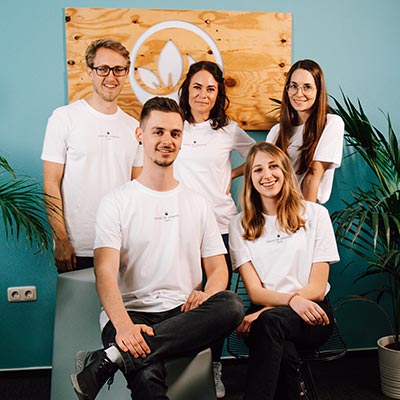
Our team in Bali – 11 wonderful people – gets up every morning and collects plastic. Not because it's glamorous. But because it's necessary. And because it works.
My vision: Plastic will eventually no longer be seen as trash, but as what it is – a valuable raw material that should not end up in the ocean. And until then? We'll get it out. Kilogram by kilogram.
What I learned from this journey
When I look back today – from the quarry lake across the North Sea, Airbus, Sri Lanka, Bali to Augsburg – I see a common thread: Do what feels right, even if it seems crazy.
Buy a kite on eBay at 12? Crazy. Build a winch? Crazy. Quit a secure job to remove plastic from the sea? Definitely crazy. But it was precisely these crazy decisions that brought me here.
And the best part: I'm not doing this alone. I'm doing this with over 165,000 people who prove every day that small decisions can make a big difference.
Become part of the story 💙
300,000 kg of plastic from the ocean – and we're just getting started
Every Oceanmata product removes 1 kg of plastic from the ocean. You decide if it becomes 300,001.
🐚 Sustainable Phone Cases | 🌊 Ocean Bracelets | 🔥 Bestsellers
Entdecke passende Oceanmata Produkte

