



Imagine not throwing your old phone case into the general waste bin – but into your compost. Sounds crazy? It's not. At Oceanmata, we designed our phone cases specifically for this purpose: as biodegradable cases that, at the end of their life, simply return to what they once were. Earth. 🌱
But what exactly happens? How long does it take? And most importantly: What's the difference if the case is not compostable? We took a closer look – with real numbers from our work in Medewi, Bali. 🌊
The Problem: What really happens to normal phone cases
Try to imagine this number: Over 1.5 billion phone cases are sold worldwide every year. The majority are made of conventional silicone or polycarbonate – in other words, plastic. And this plastic takes up to 500 years to decompose. (Sources like NABU confirm this timeframe for plastics.)
This means: Every single case that goes into the trash today will still be there in the year 2527. For your great-grandchildren. Just… there. In some landfill, in a field, or – in the worst case – in the ocean. According to scientists, approximately one truckload of plastic waste ends up in the sea every minute. Meanwhile, about 80 million tons of waste have accumulated on the seabed and the water surface.
When Dominik first truly saw what that meant during a surf trip to Sri Lanka in 2018 – beaches full of plastic, sea turtles swimming among plastic bags – he knew: There had to be another way.
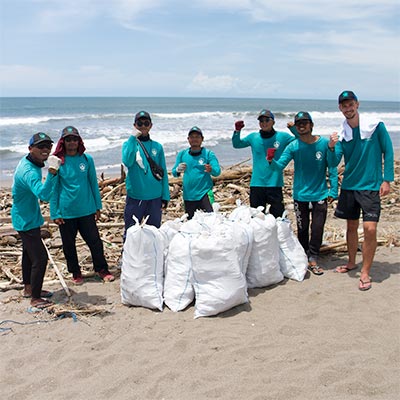
Today, with an 11-person team in Medewi, Bali, Oceanmata collects at least 1 kg of plastic directly from the ocean for every product sold. Over 165,000 ocean heroes are already part of our community. But we also know: collecting plastic alone is not enough. We also need to stop producing new plastic.

The Idea: A phone case that disappears into thin air – almost
Our Oceanmata phone cases are made from a biodegradable material. The idea was simple: because we can never control where a case actually ends up – whether in compost, a landfill, or, in the worst case, in nature – it should decompose as gently as possible in all these scenarios.
How a compostable phone case decomposes
This is where it gets interesting – because exactly what happens depends entirely on where the case ends up:
Scenario 1: Industrial Composting (optimal) ⏱️ 4–6 months
In an industrial composting facility, temperatures reach 55–60 °C. Microorganisms and fungi immediately begin to decompose the material – just as they would with an apple core or leaves. The case breaks down into water, CO₂, and biomass. No microplastics. No toxins. Simply… gone.
This is the best-case scenario – and incidentally, also the one we at Oceanmata had in mind when Dominik conceptualized this case during his student project.
Scenario 2: Home Composting ⏱️ 12–24 months
On a home compost heap, it takes longer. Temperatures are lower (especially in winter), and microorganisms work more slowly. But they work! The case slowly decomposes – piece by piece – while also nourishing your compost. Bonus: The biomass created? You can use it for tomatoes next year.
Scenario 3: General Waste / Landfill ⏱️ Years to Decades
If the case ends up in general waste, it's not ideal – but still better than conventional plastic. Landfills often lack oxygen, which slows down decomposition. Nevertheless, even under these unfavorable conditions, the compostable case breaks down within years instead of centuries.
Scenario 4: In Nature 🌿 1–3 years
If the case somehow ends up in nature (which, of course, no one hopes for) – it decomposes there under the influence of sun, rain, and microorganisms. It does not turn into microplastics. It becomes part of the natural cycle. This is the crucial difference to a conventional plastic case, which pollutes the soil and water for centuries.
The Test: How we verify its compostability
"Biodegradable" is not a protected term. We know that. That's why it's important for us to be honest with you. Our phone case was conceptualized by Dominik as a student project and developed into a prototype in Germany. The fine-tuning then took place with our partner in China.
For a material to be considered (industrially) compostable, it must meet certain standards – for example, the EN 13432 norm in Europe. This stipulates that a material must decompose by at least 90% within 6 months under industrial composting conditions – without toxic residues.
Our Goal: We are constantly working to make our cases even more transparent and sustainable. Because we know that a compostable phone case alone won't save the world. But it's one piece of the puzzle – and an important one.
The difference at a glance
| Criterion | Normal Phone Case | Oceanmata Phone Case |
|---|---|---|
| Material | Petroleum-based Plastic | Biodegradable Material |
| Decomposition Time | Up to 500 years | 4–24 months |
| Microplastics | Yes | No |
| Decomposition Residues | Toxic Residues | Water, CO₂, Biomass |
| Additional Impact | None | 1 kg of plastic from the ocean 🌊 |
"It costs a little more, but the feeling is different"
"When you buy something from Oceanmata, it's so easy. It costs a little more, but I have a completely different feeling when it arrives."
That's how one Oceanmata customer put it. And that's exactly what it's about: not buying the perfect product, but the better one. With a good feeling.
Our reviews speak for themselves: 4.76 out of 5 stars, based on over 10,000 reviews. This isn't marketing jargon – these are real people who have chosen a different kind of phone case. And that's despite there being cheaper alternatives everywhere.
What you should do with your old phone case
Okay, you now have a compostable case. But what do you do with the old one – the plastic one? Don't just throw it in the garden (it won't decompose there). Here are the best options:
- Specialized Recycling: Some municipalities offer electronics recycling that also accepts phone accessories. Ask your local recycling center.
- Upcycling: Old cases can be used as coasters, pen holders, or even small plant pots for herbs – get creative!
- Proper Disposal: If in doubt, the old plastic case belongs in the general waste bin – NOT in the yellow recycling bin. There, it would disrupt the recycling of other materials.
💙 Bonus Tip: While you're thinking about your old case, you might want to take a look at our Oceanmata phone cases for iPhone or the phone cases for Samsung. And for those who like something a little more special: our bracelets & necklaces made from Ocean Plastic.
Our Promise: No Green Lies
Let's be honest: A phone case won't save the world. We know that, and we say it openly. What we do is a small part of a much larger puzzle – alongside daily beach clean-ups, river barriers that capture plastic before it reaches the sea, educational lessons in local schools, and free bins for locals in Medewi.
What we do not do: Greenwash. We don't exaggerate. We don't promise the world. We show you what we do, and hope that's enough for you. (And so far, it seems to be – 165,000 ocean heroes can't all be wrong.)
Conclusion: What really happens?
If you put a compostable phone case on the compost – and have patience – it disappears. Just like that. Within a few months to years, it turns into earth. No microplastics, no toxins, no "we have a problem in 300 years."
This is not a miracle. This is material science. And it's the difference between a product that leaves a mark on the planet – and one that doesn't.
🌊 Ready for your compostable phone case?
Every time you buy an Oceanmata phone case, we collect 1 kg of plastic from the ocean in Medewi, Bali. No greenwashing. No compromises. Just good products with real impact.
You might also be interested in
👉 Sustainable phone cases compared: What materials are there?
👉 How we recycle Ocean Plastic in Bali – step by step
👉 WWF: Plastic waste in the oceans
Entdecke passende Oceanmata Produkte